

University of Debrecen
StateMedicine
Hungary's second city and a major medical centre
Debrecen had 202,130 residents as of 1 January 2025, which places it second in Hungary by population. Its one large higher education institution, the University of Debrecen, teaches more than 34,000 students across 13 faculties, including more than 7,700 international students from 140 countries. The city has an international airport, a main railway station called Nagyállomás and four smaller stations.
The settlement first appears in writing in 1235, as Debrezun, in the Váradi Regestrum, a collection of judicial records. It held market-town privileges from 1361 and became a free royal city in 1693. The railway line to Budapest was completed in 1857, and in 1884 Debrecen became the first Hungarian city with a steam tramway.
The rest of the monthly budget is quoted in euros: rent 165-330 EUR, food 110-220 EUR, transport 3-28 EUR. A typical all-in month comes to 510 EUR. That figure assumes a student with their own room in a shared flat, cooking at home most days and using the discounted student transport pass, and it covers bills, phone, course materials and a normal amount of going out.
Local transport is run by the municipal operator DKV Zrt. (Debreceni Közlekedési Vállalat), which works trams, trolleybuses and buses. Trams have run in the city since 1911. There are two tram lines: Line 1 from Nagyállomás to Egyetem, 4.4 km and 12 stops, and Line 2 from Nagyállomás to Doberdó utca, 5.0 km and 13 stops, opened in 2014. Alongside them run five trolleybus lines and about 60 bus lines. Fares valid from 24 December 2025 apply across all three modes: a single line ticket is 500 Ft on paper or 480 Ft by mobile, a 1-hour mobile ticket is 560 Ft, a 1-day pass 1,700 Ft, 3-day 3,600 Ft and 7-day 4,500 Ft. The full-price monthly pass is 9,200 Ft electronic (9,600 Ft paper), while the student monthly pass is 5,300 Ft electronic (5,500 Ft paper), about 42% below the full-price pass. The student Hajdú-Bihar county pass is 945 Ft.
The one institution we list here is the University of Debrecen, a state university. Its origins go back to the Református Kollégium, founded in 1538, which is the direct predecessor of the university. The modern institution was created by Act XXXVI of 1912 as the Hungarian Royal University of Debrecen and began teaching in 1914. It now runs 13 faculties and draws international students from 140 countries.
The first housing option is a state dormitory place. The university's dormitory fee table for the 2026/2027 academic year, valid from 1 September 2026, puts the price at 40,000-47,600 HUF per person per month. The figure depends on the building and the room type: Kossuth Lajos III is 34,500 Ft, Markusovszky Lajos III 35,500 Ft, Markusovszky Lajos II 38,500 Ft, Arany Sándor Diákapartman 42,000 Ft, Campus Hotel 38,000 Ft in a triple and 42,000-44,000 Ft in a double, and a double in Kossuth Lajos I-II 41,000 Ft. Multi-bed rooms in the Tisza István, Weiner Leó and Borsos József dormitories sit at the bottom of the table at 25,500 Ft, while a single room in Kossuth Lajos I is at the top at 74,000 Ft. A typical double room lands around 38,000 to 44,000 Ft. The fee covers a furnished room, bedding, internet, utilities and use of the shared kitchen and laundry. Two one-off charges sit outside the monthly price: a cultural contribution of 9,000 Ft per academic year and a maintenance deposit of 9,000 Ft, both paid before move-in and halved for students arriving in the spring semester. Out-of-town dormitories in Nyíregyháza, Szolnok, Hajdúböszörmény and Vámospércs fall outside this range.
The second option is Study K&M, the privately operated student residence the university lists among its accommodation options. Its long-stay student table for 1 September 2026 to 1 July 2027 gives 225,000 HUF per month for a single studio and 330,000 HUF per month for a double studio. Those are per-room prices, so per person that works out to 225,000 Ft alone in a single studio and 165,000 Ft each when two people share the double, a per-person span of 165,000-225,000 HUF. The price includes utilities, internet, air conditioning, weekly cleaning, a linen change every two weeks and VAT. Tourist tax of 400 Ft per adult per night is charged separately. These are self-contained serviced studios in a hotel-run residence, which is where the gap with a dormitory bed comes from.
If Debrecen is on your list, we can work through the programme choice, the decision between a dormitory place and a private studio, and how to build a realistic monthly budget. We make no promises about the outcome of an application. What we do is make sure the numbers and the timeline in front of you are accurate when you decide.
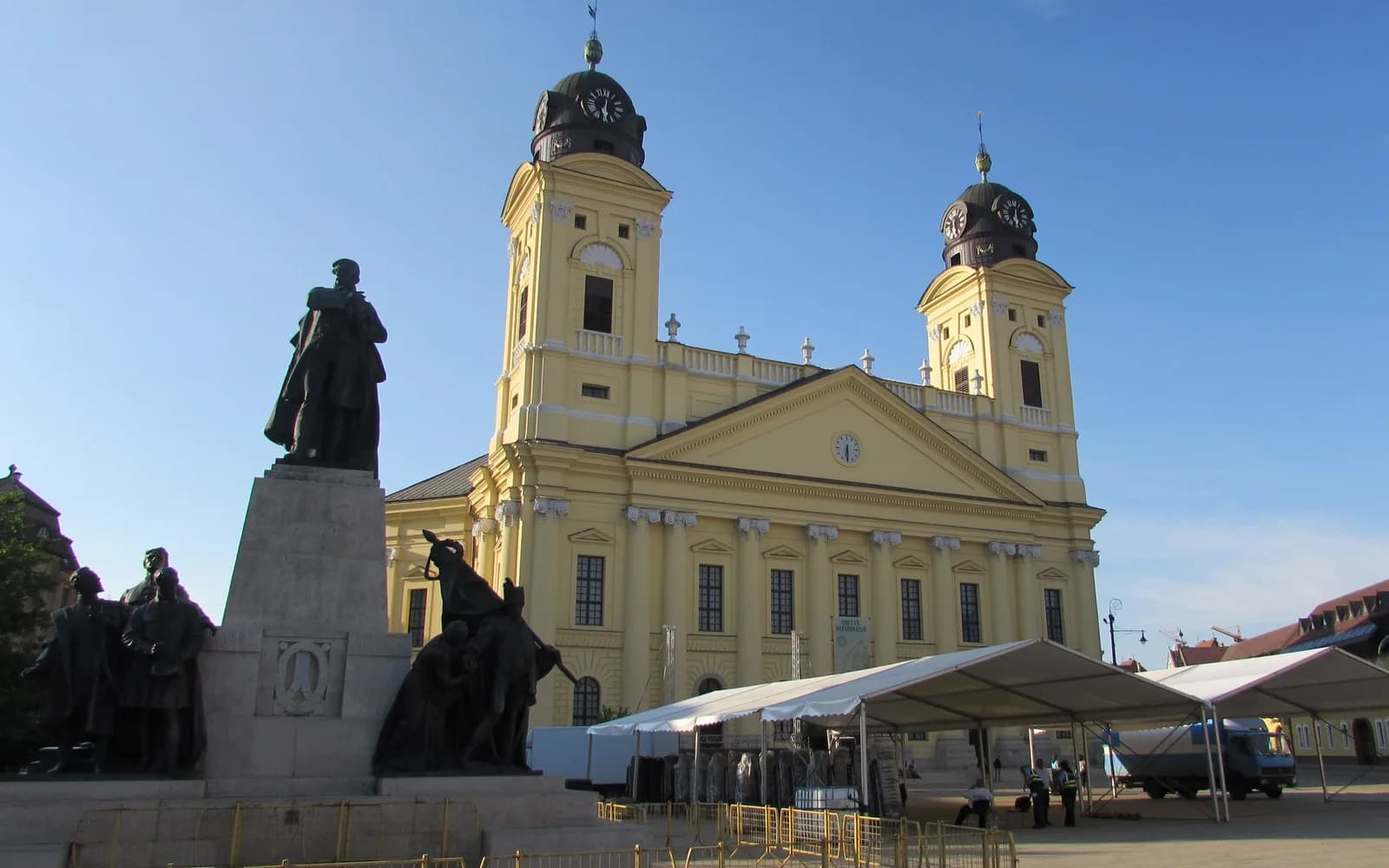
On 14 April 1849 Lajos Kossuth proclaimed the Hungarian Declaration of Independence and the dethronement of the Habsburgs in the Great Reformed Church of Debrecen; the city had been the seat of the Hungarian government since January 1849, and it served that role a second time at the end of the Second World War, in 1944-45. In the Battle of Debrecen, fought from 6 to 29 October 1944, the Soviet 2nd Ukrainian Front under Marshal Malinovsky and the Romanian 1st and 4th Armies faced the German 6th Army under Fretter-Pico together with the Hungarian 2nd and 3rd Armies. The city was taken on 20 October 1944, and roughly 70% of its buildings were damaged during the war, including in the bombing of August 1944. More recently, BMW Group opened a vehicle plant on a site of more than 400 hectares, where series production of the BMW iX3 started at the end of 2025.