

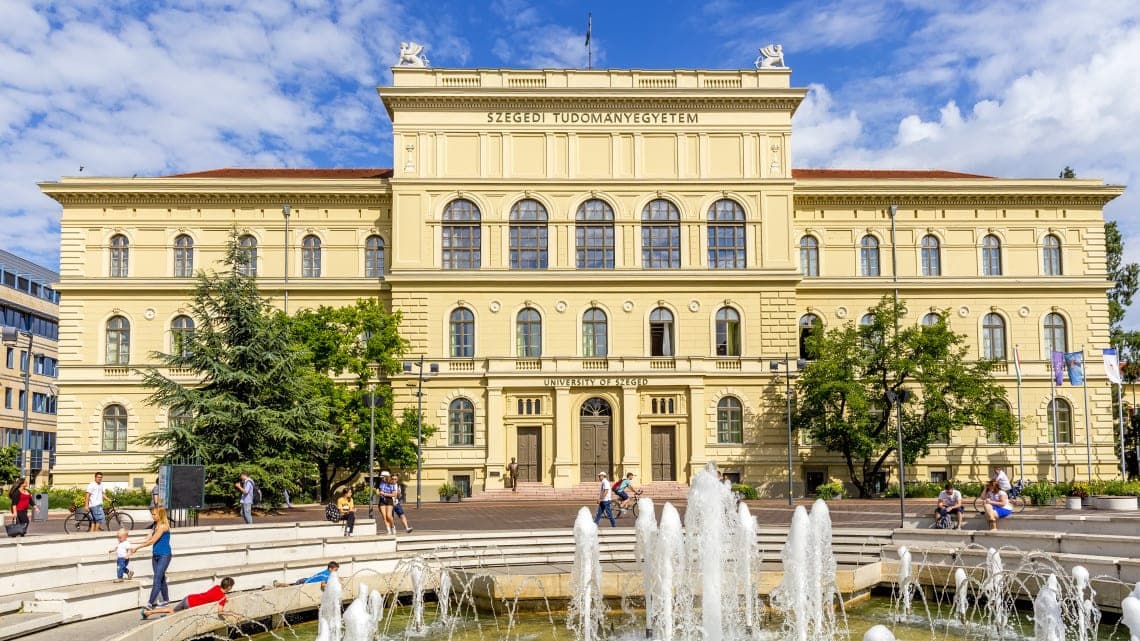
University of Szeged
StateMedicine
A peaceful university town known as the 'City of Sunshine'
Szeged first appears in writing in 1183, as Ciggedin, in a charter of King Bela III concerning salt shipping on the Maros river. Ptolemy had already named a Roman-era settlement in the area, Partiscum, in the 2nd century AD. The city had 157,282 inhabitants as of 1 January 2025 and ranks third among Hungarian cities by population.
Monthly living costs break down in euros as follows: rent 124-220 EUR, food 115-349 EUR, transport 16-27 EUR. A typical all in monthly figure is 396 EUR. That figure assumes a student with their own room in a shared flat, cooking at home most days and using a discounted student transport pass, and it covers bills, phone, course materials and a normal amount of social spending.
Local transport is run by Szegedi Kozlekedesi Tarsasag (SZKT). The tram lines are 2, 3, 3F and 4, while line 1 runs as a tram-train service. Trolleybus lines are 1E, 3FV, 5, 6, 8, 9, 10 and 19. Local buses are operated by Volan on the same ticketing system. Under the fares published on szkt.hu and effective from 1 January 2024, the student monthly pass (tanulo havi berlet) costs 5,800 HUF against a general monthly pass of 9,600 HUF.
If Szeged is on your list, we can work through programme choice, application timing and a realistic monthly budget with you. We will set out the steps and the costs plainly and leave the decision to you.
The university carries part of that history. The University of Kolozsvar, founded in 1581 by Istvan Bathory, was relocated to Szeged in 1921 after Transylvania passed to Romania, and the first Szeged academic year opened on 9 October 1921. Albert Szent-Gyorgyi, working at Szeged, received the 1937 Nobel Prize in Physiology or Medicine for his work on vitamin C. The one institution we list in the city today is its successor, the University of Szeged, a state university.
The Ottoman period in Szeged is dated from 1526 to 1686, and Turkish rule ended in 1686. In July 1849 the city became the last seat of the Hungarian revolutionary government, and Kossuth gave his final public address there on 12 July 1849.
On the night of 11-12 March 1879 the Tisza broke the Petres dike and flooded the city. Of 5,723 houses only 265 were left standing, and 165 people died. The city was rebuilt afterwards on a ring-and-avenue plan.
Industrially the city is identified with paprika, which reached Szeged in the second half of the 16th century, and with the Pick salami works, traced back to the shop Mark Pick opened in 1869. During the Second World War German troops occupied the city in March 1944, the Jewish ghetto was liquidated in June 1944, and 6,000 inhabitants of the city were killed.